


Kevyn O’Connell: From coffee breaks to cohesion policy
A Canadian researcher's summer inside Slovenia's regional development system
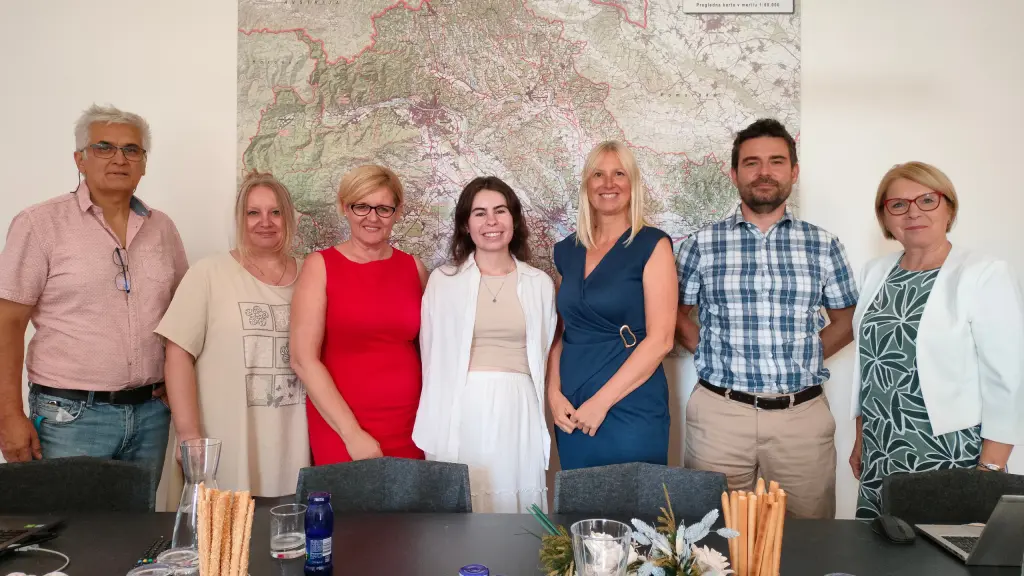
Kevyn O’Connell spent 11 weeks in Slovenia as an ASEF Visit Slovenia Junior Fellow 2026, hosted by the Slovene Regional Development Fund (SRRS) in Ribnica. Her comparison of Slovenian and Canadian regional development gave the Fund fresh ideas – and gave her a connection to her great-grandparents’ homeland that goes well beyond tourism.
Roots, rediscovered
Kevyn’s link to Slovenia runs through her mother’s grandparents, who were both born here. This summer was her second visit to the country, but the first that felt like more than sightseeing. “Before, I felt the connection to my Slovenian heritage was superficial – I’d only visited the country as a tourist, had no Slovenian friends and did not speak the language,” she says.
She arrived with no prior work experience in regional development, which made the topic all the more exciting: how regions improve the lives of the people who live in them. She explains it simply: “My research with ASEF is really about regional development – this is how countries make the quality of life for its inhabitants better.”
Slovenia’s regions, she notes, face familiar obstacles, from limited funding to a lack of data for tracking progress. “Since it can be helpful to learn from other countries, my project is about how Canada handles its own regional development, and what lessons Slovenia can take away from this system.”
Inside Slovenia’s regional development system
The Slovene Regional Development Fund, based in Ribnica, offers loans and grants on more favourable terms than commercial banks to businesses, farmers, non-profits and municipalities. Kevyn was the first fellow the Fund had ever hosted. Under the mentorship of Matjaž Ribaš, she was introduced to the Fund’s vision, mission, financial products and development goals, and then rotated through its departments to see each support instrument at work.
The fellowship also took her beyond Ribnica. She got to know the Institute of Macroeconomic Analysis and Development (UMAR) and the Ministry of Cohesion and Regional Development, met the regional development agency for the Podravska region, and – with a Ministry colleague – visited the Kurent House in Ptuj to learn about Kurentovanje. What struck her most was the sheer number of actors: “not just the Slovenian Regional Development Fund, but the Ministry of Cohesion and Regional Development, twelve development agencies, working groups, municipalities etc.” The Fund itself gave her a perspective she could not have gained at home.
“There is not really a direct correlation to this kind of institution in Canada,” she says, “so learning about how the Fund operates and uses loans/grants to address regional disparities was something that would be quite difficult to replicate in Canada.”
Kevyn gave two presentations to her colleagues. The first introduced her academic path, research interests and Canada’s political and economic system. The second presented her findings, Slovenia and Canada: Comparing regional development frameworks, performance indicators, and sustainability trends. It showed that Canada relies on regional development agencies with clearly defined goals and performance indicators, while Slovenia delivers much of its regional development through EU cohesion policy and national mechanisms. The aim was to identify good practices that could help SRRS develop its instruments and strengthen its role in sustainable, inclusive regional development.
Working across three organisations meant writing for several audiences at once – her biggest unexpected lesson.
“I would not change this experience at all, as it has helped me understand just how many stakeholders can be involved at once. This is the reality of public policy, after all.”
Coffee, Maribor and a lasting connection
For Kevyn, the real Slovenia was found between meetings. “I think that truly connecting to a country is not a matter of seeing as much of the physical landscape as possible, but rather talking with the people who live there,” she says. “I learnt so much about my coworkers in the small moments between work – about their hobbies, studies, interests and families.”
Her strongest memory, though, is the ASEF Weekend Getaway – her first real encounter with other young people of Slovenian heritage from abroad. Slovenian fellows from the Research Abroad programme introduced the visitors to local culture.
Over 11 weeks she also took a Slovenian language course and made friends across the country. She plans to return more often, take another language course and stay active in ASEF events. As ASEF’s only Canadian ambassador, she also feels responsible for promoting and contributing to ASEF’s research in economics – “something I would not have incorporated into my future plans without ASEF.”
For SRRS, the first hosting experience was a clear success: it brought international knowledge exchange, visibility for the Fund’s work and new links for future cooperation. Kevyn’s advice to anyone still undecided is short.
“Do it – there are no downsides. You’ll take more out of it than you think you will!”
Program supported by: