


Postcard from Cambridge: Exploring methods for spatial transcripotmics at the University of Cambridge
Postcard from Cambridge: Exploring methods for spatial transcripotmics at the University of Cambridge
Written by: Matej Jelenc
The ten weeks I spent at the Department of Computer Science and Technology at the University of Cambridge, working under the supervision of Prof. Mateja Jamnik, proved to be a formative experience, both scientifically and personally, and a real test of independence in an entirely new setting. My research brings together artificial intelligence and biology, with a focus on spatial transcriptomics, a family of technologies that measure which genes are active in a tissue while preserving where in the tissue each measurement was taken. As these datasets have grown, so-called foundation models have emerged: large neural networks, pre-trained on millions of cells, that aim to capture biologically meaningful patterns in gene expression.
Despite their scale, these models frequently fail to beat far simpler methods. Because spatial data come from many different technologies and remain relatively scarce, it is still unclear how well these models actually perform. I therefore set out to study the current models and to develop a benchmark that evaluates them fairly and robustly across different technologies and biologically relevant tasks. Along the way, comparing these models with approaches from other corners of machine learning has sparked some promising ideas for building better models in the future.
Being part of Prof. Jamnik’s group was a great source of inspiration, and I am thankful for the guidance, feedback and weekly discussions that helped shape my work. The project is still in progress, and our collaboration will carry on remotely. The visit helped me grow as a researcher and opened the door to lasting connections with colleagues abroad.
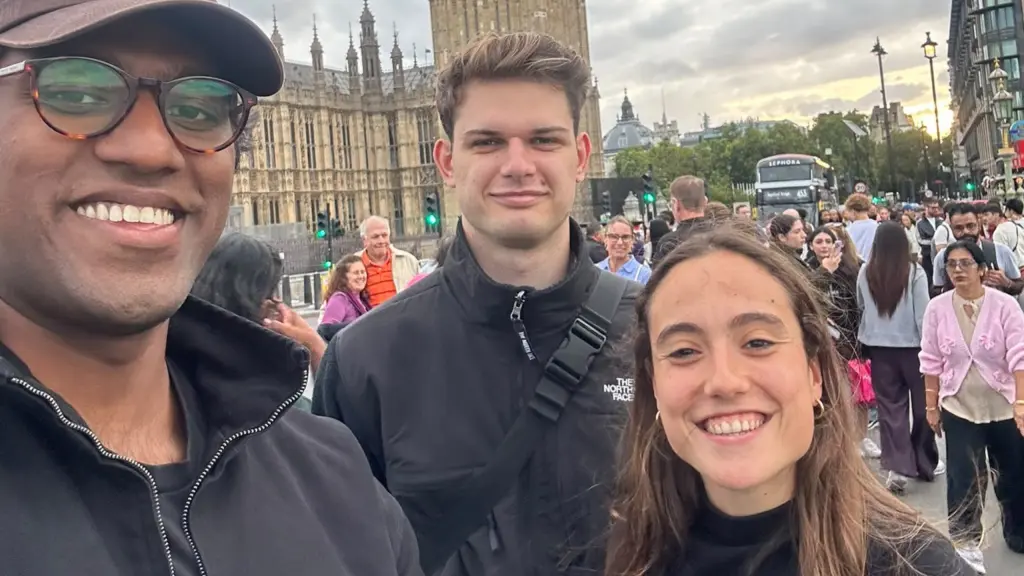
Away from research, I spent much of my free time with other visiting students, playing sports and exploring Cambridge and its colleges. I also made several trips to London, where I visited its museums and galleries, saw Christopher Nolan’s The Odyssey in IMAX and toured the Warner Bros. studios where the Harry Potter films were made. In a funny twist of fate, it took a trip to Cambridge for me to finally meet one of my Slovenian classmates. We had attended the same lectures for three years but only spoke for the first time after running into each other in the city centre.
Living and working in such a diverse, international community is something I will carry with me for a long time. I sincerely thank Prof. Jamnik and her group for their warm welcome and for everything I learned from them, and to the ASEF team for giving me this opportunity.