


ASEF Speaker Series: Artificial Intelligence and the Future of Knowledge with Dr. Aleks Jakulin
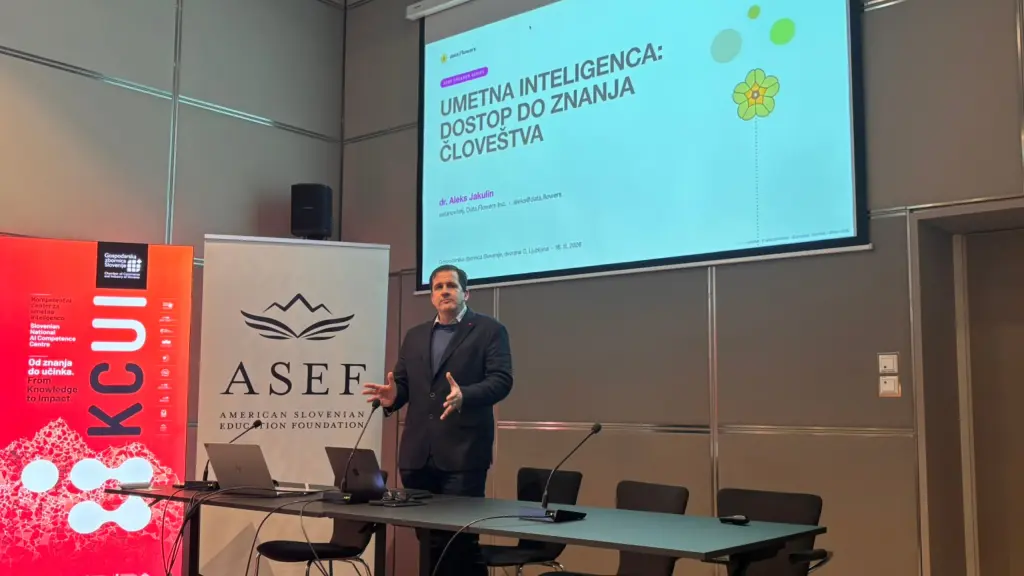
ASEF Speaker Series: Artificial Intelligence and the Future of Knowledge with Dr. Aleks Jakulin
On Wednesday, 18 November 2026, the lecture “Artificial Intelligence and the Future of Knowledge” took place at the Chamber of Commerce and Industry of Slovenia as part of the ASEF Speaker Series. The ASEF Institute organised it together with the Slovenian National AI Competence Centre (KCUI). The speaker was Dr. Aleks Jakulin, founder of Data.Flowers, who did his PhD under Prof. Ivan Bratko at the University of Ljubljana. Jakulin compared AI to fire: it can burn us, but the best protection is to understand it. Instead of asking whether we want fire, he said, we should ask how to handle it.
If AI is fire, data is its fuel. Jakulin described large language models as a compressed library. In his view they are not an intelligence above ours but better-connected human knowledge, only as good as the data behind it. With examples from recent decades, he showed how new technologies relied on sources that they then weakened. Search engines did this to curated web directories, social networks to journalism, and online retail to physical shops. Generative AI is repeating the pattern. He argued that the key challenge is to secure a long-term supply of reliable, verified knowledge.
We don’t regulate fire itself; we regulate how we build, store fuel and handle explosives. In the same way, Jakulin argued, AI regulation should focus on what surrounds AI, above all on stopping data from piling up in a few opaque places. As an alternative, he described a layered system that works like a natural ecosystem. Personal devices would keep our own data, while communities share infrastructure and data. He compared today to the shift from the centralised Bronze Age to the more decentralised Iron Age, and suggested that capable models running locally could make communities more self-sufficient. He concluded that rules should make doing the right thing pay off, because expecting ethical people to sacrifice themselves is itself unethical.