


AAIC 2026 – From Idea to Industry: How Artificial Intelligence Is Reshaping the European Innovation Landscape
AAIC 2026 – From Idea to Industry: How Artificial Intelligence Is Reshaping the European Innovation Landscape
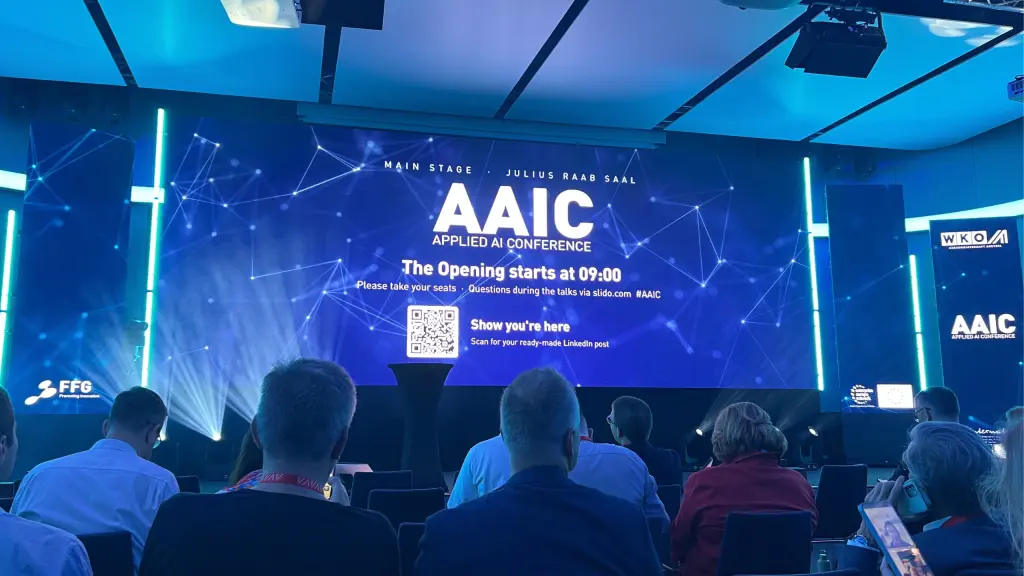
At the end of September, the Federal Economic Chamber of Austria in Vienna hosted one of the region’s largest events in applied artificial intelligence – the Applied Artificial Intelligence Conference (AAIC 2026). The one-day event, which brought together experts, innovators, and decision-makers from more than 12 countries, was also attended by members of the ASEF Institute team. At the heart of the discussions was a key question: how to safely, efficiently, and sustainably transfer theoretical advances in AI technologies into the real economy and society.
Until technology finds its way into practical application, it remains merely untapped potential. This guiding principle echoed throughout the entire conference, where representatives of Austrian business and politics presented steps to elevate the digital maturity of companies. With investments totaling €5.5 billion in applied science and a network of European Digital Innovation Hubs (EDIH), Austria aims to become one of the top five leading countries in the field of AI in Europe.
Slovenia also sets clear goals in this area. Despite a smaller financial footprint in absolute terms, our country boasts an exceptionally strong research foundation with a long tradition, along with an international research center under the auspices of UNESCO (IRCAI). Under the adopted National Strategy for Artificial Intelligence (NpUI 2030), Slovenia plans to allocate around €110 million in public investments by 2030 (Source: Ministry of Digital Transformation of the Republic of Slovenia) to accelerate the transfer of knowledge from academic spheres into the economy and strengthen the digital transformation of small and medium-sized enterprises through national hubs, such as EDIH DIGI-SI. An important building block in connecting research, education, and the practical application of AI in Slovenia is also KCUI (Competence Center for Artificial Intelligence) – of which the ASEF Institute is a part – serving as a focal point for promoting innovation, international collaboration, and the transfer of best practices into the local environment.
From Pilot Projects to Mass Adoption: How Tech Giants and Creators Deploy AI
Implementing artificial intelligence into large-scale systems brings specific challenges. Verena Trost from IBM presented the tech giant’s approach, which relies on the principle of “elimination, simplification, automation.” She emphasized to attendees that competitive pressure will make AI investments inevitable in the future, but success will not depend on technology alone, but rather on focusing on people – through proper reskilling and behavioral change.
Clara Cordes, Product Manager at Canva, addressed the distinct nature of AI technology. Unlike traditional, deterministic tools that consistently produce the exact same result from the same input, AI requires an entirely new creative process, she noted. At Canva, they encourage a shift from initial idea to final result through so-called visual AI, which enables rapid testing and adaptation of ideas.
The Innovation Accelerator and Speed of Development: Where Are the Limits?
The speed of development in programming and automation is remarkable. As highlighted by participants in the panel on AI as an innovation accelerator – moderated by Dr. Reinhard Willfort (university lecturer in Graz and Vienna, ISN member) alongside a presentation by Jeremias Fuchs (Localmind) – development teams needed half a year to build an initial prototype just a few years ago, whereas today they can prepare working solutions in mere days.
However, this extraordinary speed comes with warnings from developers: if we hand over entire creative and technical processes to automation too quickly, we risk finding ourselves in a few years without adequately trained specialists who understand the underlying mechanics of these processes.
AI in Manufacturing: From Bakeries to Carpentry Workshops
A special emphasis at the conference was placed on the application of AI in the manufacturing industry. Franz Sumecz (AI5Innovation) presented the “Test Before Invest” (TBI) concept, which allows small and medium-sized enterprises to safely test digital solutions before making a financial commitment.
Concrete real-world examples were presented by Michael Rossbory (COMET Centre), who demonstrated the use of machine learning for the automatic optimization of industrial machinery parameters, drastically reducing setup times – the effectiveness of this solution has been confirmed with examples from the baking industry, among others. Christian Wogerer (PROFACTOR) showcased the role of AI and robotics in flexible automation and labor cost reduction, which is already being successfully applied in carpentry and furniture manufacturing.
Oversight, Ethics, and Building a Sustainable Ecosystem
An important message of the conference was delivered by Daniel Eder (Akkodis), who stressed that an AI strategy is no longer a technical question, but a business one: “The future is not about AI everywhere, but about AI that we can still control.”
In the closing panel, founders and representatives of supporting institutions (Sistema, Ketryx, FFG, Advantage Austria) discussed building a supportive ecosystem for AI companies. They agreed that the region offers an exceptional quality of life and strong technical universities, attracting top engineers to Austria. Furthermore, strict European regulation (such as the EU AI Act) and a focus on ethical AI do not necessarily represent an obstacle; rather, they can become a key competitive advantage in building trustworthy and reliable solutions.
What Does Participation Mean for ASEF?
Attending AAIC 2026 offered members of the ASEF Institute an invaluable insight into current global and regional trends as well as market demands. As an organization dedicated to the circulation of knowledge and supporting young talents, we integrate these insights into our reflections on developing our educational and research programs. We believe that combining top-tier knowledge, ethics, and practical applicability is precisely what will empower young talents to create breakthrough solutions with a positive impact on society.