

BioX Reading Club, New Season Kick-off: Franz Görlich

From Atoms to Algorithms: Simulating Biomolecules with Machine Learning
Franz Görlich, a doctoral student at the Technical University of Munich (TUM), gave a lecture on 19 November 2026 on biomolecular simulations and the use of machine learning in these simulations. He began with the physical foundations of molecular modeling and then presented methods that allow faster calculations.
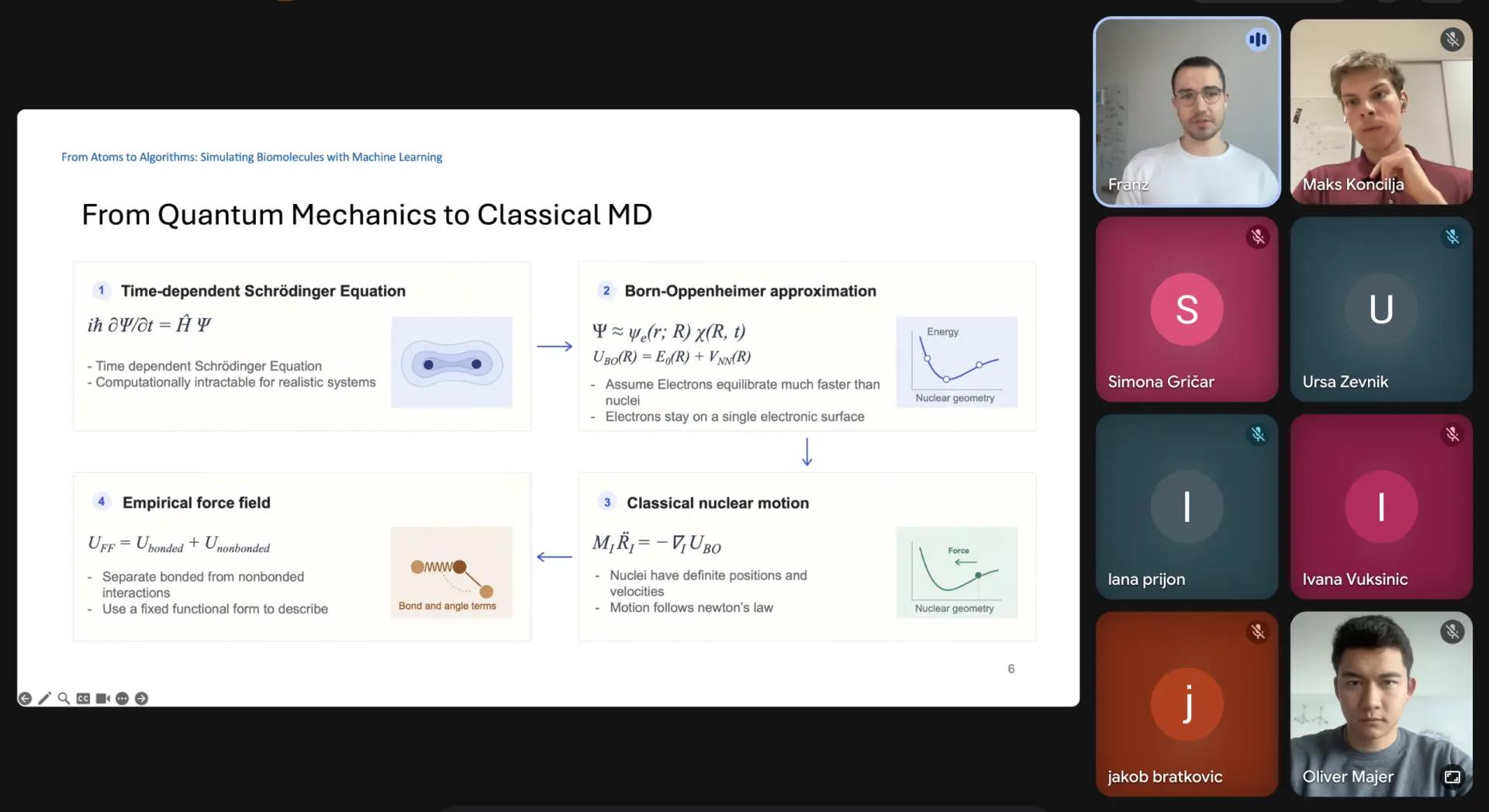
He first introduced the Born–Oppenheimer approximation, in which the motion of the atomic nuclei is treated separately from the motion of the electrons. Because electrons are much lighter than atomic nuclei, we assume that they adjust almost instantly to changes in the positions of the nuclei. He then discussed the classical description of the motion of atomic nuclei. To make simulations less computationally demanding, conventional classical models use further simplifications, such as fixed atomic connectivity and predefined partial charges. As a result, however, they can no longer properly describe chemical reactions, in which bonds form or break, or charge transfer.
The speaker also presented machine learning potentials. These are trained on quantum mechanical calculations to predict the potential energy and the forces between atoms, so these quantities no longer have to be computed with more demanding methods at every simulation step. Unlike conventional classical force fields, properly trained models can also describe the formation and breaking of chemical bonds, and therefore chemical reactions. Some models can also describe charge redistribution, or charge transfer.
He also highlighted coarse-grained modeling, in which groups of atoms are represented by a smaller number of particles. This reduces the number of degrees of freedom and simplifies the simulation, although some detail about the system is lost. This approach is especially useful when we are more interested in the behavior of a larger molecular system than in the motion of individual atoms.
In the final part of the lecture, he discussed the protein folding problem, which is predicting a protein’s three-dimensional structure from its amino acid sequence. He also gave a brief overview of the AlphaFold 2 architecture. The lecture was followed by a discussion.