


ASEF Scientific Symposium: When Data Speaks, Can We Calculate the Future?
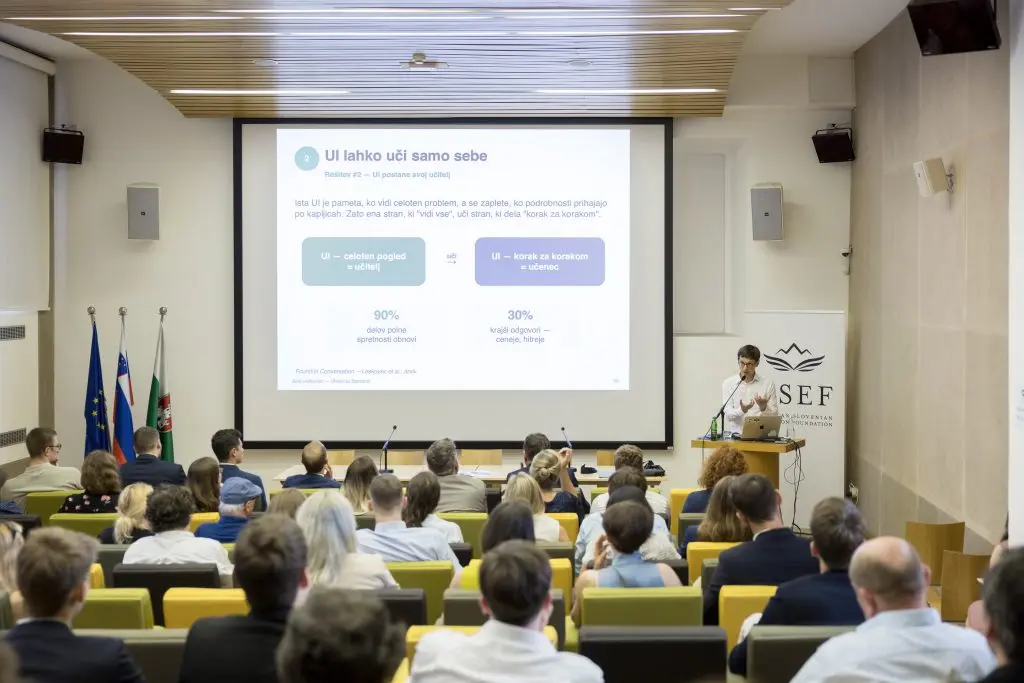
ASEF Scientific Symposium: When Data Speaks, Can We Calculate the Future?
Artificial intelligence, advanced molecular modeling, digital twins, and practical industrial challenges. This year’s ASEF Institute Scientific Symposium drew numerous professors, mentors, industry representatives, and fellows to the City Museum of Ljubljana. Together, they sought answers to a defining question of our time: Can we predict and shape the future using algorithms?
The event opened with introductory remarks by the Director of the ASEF Institute, Dr. Rok Sekirnik, who highlighted the unique nature of the ASEF network. For over a decade, the network has been creating personalized research experiences for selected talented individuals from Slovenia, with the core mission remaining the transfer of invaluable knowledge and experience back to the home environment for the benefit of society as a whole.
Top-Tier Scientific Contributions: From Process Automation to Better AI Responses
In the first part of the symposium, the audience heard from leading domestic and international experts. Prof. Marko Grobelnik (Jožef Stefan Institute) shed light on the current scientific and technological state of artificial intelligence, focusing on the automation of the scientific process itself, which has the potential to completely transform the work of researchers in the future. Prof. Dr. Julija Zavadlav (Technical University of Munich) introduced the fascinating world of molecular modeling powered by artificial intelligence. She explained how computational microscopy and machine learning can be utilized to observe the movement of atoms, and how generative models can identify which materials possess specific, desired properties. Prof. Dr. Jure Leskovec (Stanford University, ASEF Co-Founder) concluded the lecture series with a presentation on artificial intelligence as an advanced assistant in science. He presented the work of his Stanford research group, placing the greatest emphasis on a key challenge in modern development: how to use advanced methods to train AI systems to better understand context, thereby generating significantly higher quality, more precise, and more reliable answers for research purposes.
Interdisciplinary Challenges: Science on an Ice Cream Training Ground
A special highlight of the symposium was the panel discussion of the ASEF Tutorship program, moderated by Kaja Ravnak. This year’s tutorship groups focused on the United Nations’ ninth Sustainable Development Goal (SDG 9), with three of the groups directly tackling practical industrial challenges provided by the company Incom Leone. Five fellows from the 2025 generation of the “Research Abroad” program presented their essays, which have been compiled into a new proceedings: Tomaž Jurkovič (Physics and Engineering), along with his group under the mentorship of Prof. Dr. Sašo Grozdanov, investigated ice recrystallization and the temperature history of different ice cream batches to ensure more stable product quality. Maša Karčovnik (Biochemistry and Chemistry), alongside her group under the mentorship of Dr. Alen Krajnc, presented solutions for processing and recovering sugar from production wastewater. Gal Gantar (Computer Science), with his group under the mentorship of Prof. Dr. Ivan Bratko, described the development of smart AI agents and simulators on the SLAIF supercomputer. Duška Stopar (Medicine), together with her group under the mentorship of Prof. Dr. Janez Žibert, revealed a vision for proactive healthcare, the concept of a digital twin, and diagnostic ice creams. Marko Fišer (Social Sciences), alongside his group under the mentorship of Prof. Dr. Tomaž Deželan, used satellite analysis of urban heat islands to highlight the importance of spatial justice in smart city planning.
Key Takeaway of the Symposium
Numbers, algorithms, and simulators offer incredible predictive models. However, the future is not guided by calculations alone, but by people. Our mission is to combine technological innovation with a high degree of ethics, empathy, and mutual cooperation, ensuring that these advancements become a public good accessible to all.
Sincere thanks to all the speakers, fellows, tutors, and Incom Leone for their collaboration and the inspiring discussions, which once again prove that the ASEF family is successfully building strong bridges of knowledge between Slovenia and the world.
Photo credits: Aleš Rosa